
Real-Time Demo Scheduling & Matchmaking Portal for Skill-Lync
Uber-style lead-to-sales-engineer allocation system with instant demo booking, priority-based routing, and automated meeting management—delivering 5000+ demos in 3–4 months.
Executive Summary
Cybermind Works built a real-time demo scheduling and matchmaking platform for Skill-Lync, an engineering-focused EdTech company. The goal was to create an Uber-style allocation system where leads (students) can instantly connect with available sales/demo engineers through real-time matchmaking, priority-based routing, and automated meeting management.
This solution features Socket.IO-powered real-time communication, Redis-based concurrency locking, priority cascade routing (P1 → P2 → P3), automated calendar integration, WhatsApp notifications, and comprehensive analytics dashboards. The platform successfully delivered 5000+ demos in 3–4 months with zero double-booking incidents.
Problem Statement
Immediate Demo Demand
- Leads often want a demo immediately, not hours or days later
- Traditional scheduling workflows introduce significant friction and response delays
- Manual coordination creates bottlenecks in the sales process
High Drop-off Rates
- Delays increase lead drop-offs and no-show probability
- Students lose interest when they can't get instant answers
- Competitive disadvantage when other platforms respond faster
Fair Allocation Challenge
- System must ensure fair distribution of demos across engineers
- Need to handle priority-based routing (P1 → P2 → P3)
- Must prevent double-booking and allocation conflicts
Dual Mode Requirements
- Support instant demos when engineers are online
- Support scheduled demos via slots when instant isn't available
- Handle real-world abuse scenarios and keep allocation reliable
Solution Overview
Cybermind Works built a comprehensive real-time demo scheduling and matchmaking platform that combines instant allocation with scheduled booking capabilities. The system supports:
- Real-time demo matchmaking with Uber-style allocation
- Scheduled demo booking via time slot selection
- Priority-based routing (P1 → P2 → P3 cascade)
- Automated meeting management with Zoom and Google Meet integration
- Multi-channel notifications via Email and WhatsApp
- Role-based dashboards for students, engineers, and managers
- Concurrency locking to prevent double-booking
- Anti-gaming protections to handle abuse scenarios
System Architecture
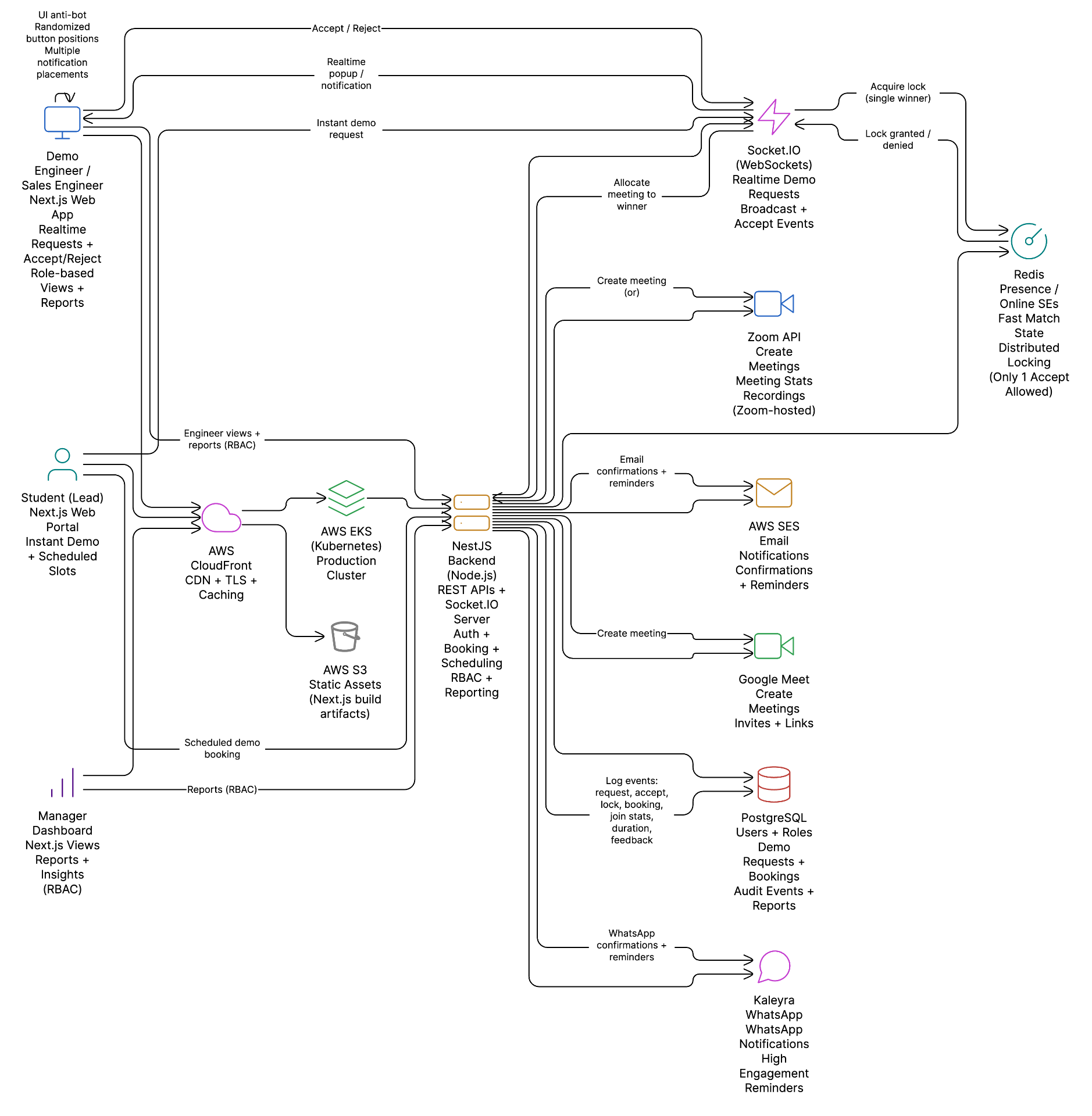
A comprehensive view of the real-time demo scheduling system, showcasing the flow from student requests through Socket.IO matchmaking, Redis locking, meeting automation, and multi-channel notifications.
Click to view fullscreen
Skill-Lync Real-Time Demo Flow Diagram
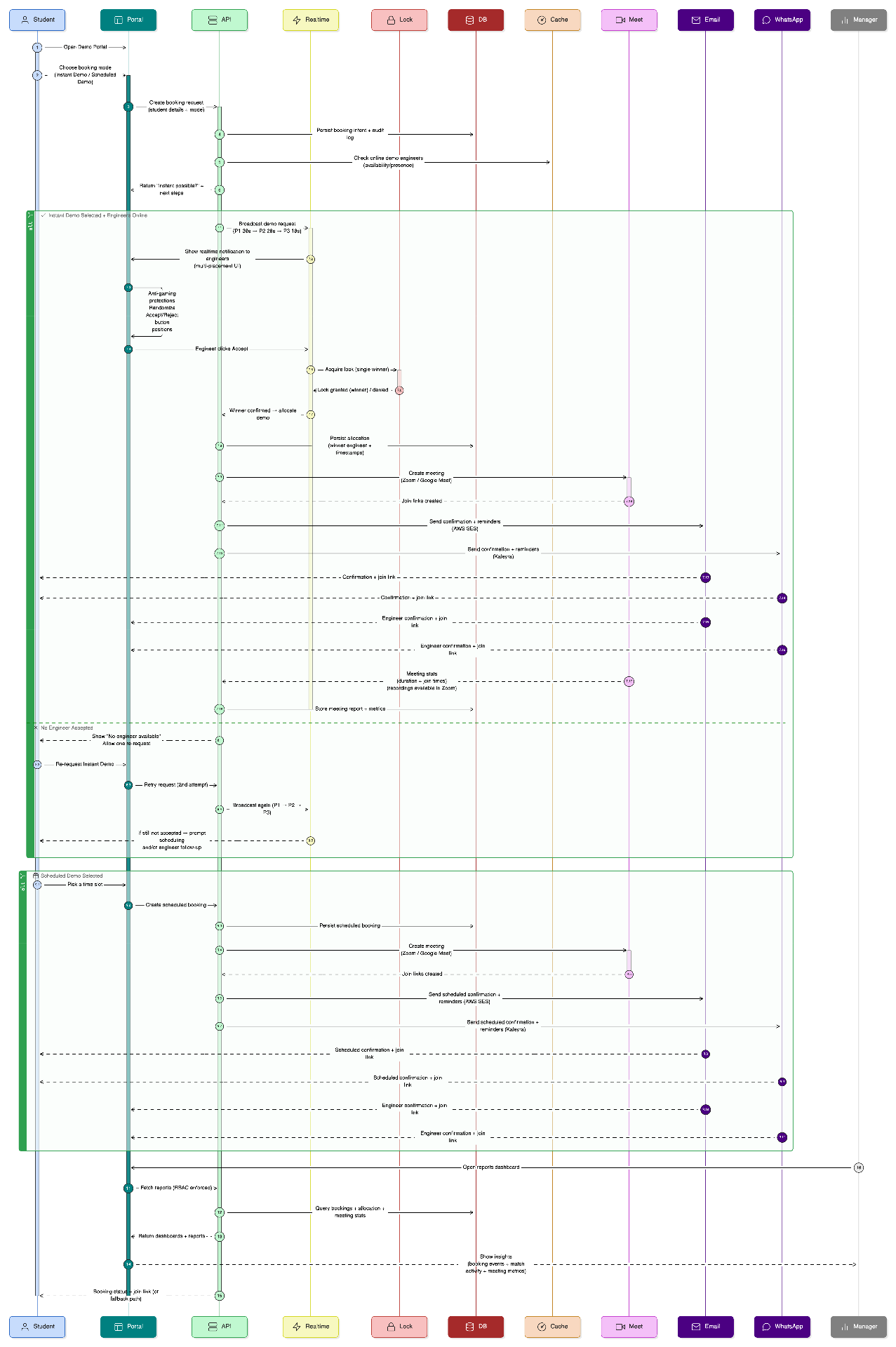
A detailed sequence diagram illustrating the complete flow from student demo request through real-time matchmaking, meeting creation, notifications, and reporting — covering both instant and scheduled demo scenarios.
Click to view fullscreen
Real-Time Demo Matchmaking
An "Uber-style" request broadcasting system where demo requests are pushed to available engineers in real-time, and the first one to accept gets the allocation.
Request Flow
Student Requests Demo
Lead initiates instant demo request
Engineers Notified
Real-time notification to available engineers
First Accept Wins
First engineer to accept gets the demo
Meeting Scheduled
Instant meeting creation with all details
Priority Routing (P1 → P2 → P3)
Instead of algorithmic scoring, Skill-Lync uses a predefined priority list with time-based cascading:
High-performing engineers get first access
Secondary priority if P1 doesn't respond
Final tier ensures request distribution
Retry & Fallback Handling
If no engineer accepts, the system provides graceful fallback options:
First Attempt Fails
Student can immediately re-request for another attempt
Second Attempt Fails
Student is asked to schedule a demo for later, and/or sales engineer follows up
Locking & Double-Accept Prevention
Real-time allocation systems face a critical challenge: multiple engineers can click accept at the same time. CyberMind Works implemented a robust locking mechanism to ensure clean allocations.
The Problem
Race Condition Scenario
When a demo request is broadcast, multiple engineers may click "Accept" within milliseconds of each other. Without proper locking, this could result in double-booking or conflicting allocations.
The Solution
CyberMind Works implemented a Redis-based locking mechanism that ensures:
- Only one demo engineer can accept a meeting
- Once accepted, the meeting is instantly reserved and scheduled
- Other accept attempts are rejected automatically
- Clean allocations under high traffic conditions
Double-Booking Incidents
Lock Acquisition Time
Allocation Reliability
Anti-Gaming & Abuse Prevention
During production usage, the system encountered a real-world challenge: some demo engineers attempted to game the allocation using auto-clicking tools to accept faster than others.
Detected Abuse Pattern
Some engineers deployed auto-clicking scripts and browser automation tools to accept demo requests faster than humanly possible, creating an unfair advantage and undermining the priority-based allocation system.
Implemented Protections
Randomized Button Positions
Accept/Reject buttons appear in different positions, making auto-click scripts unreliable and encouraging human interaction
Variable Notification Placement
Demo request notifications appear in different locations on the screen, preventing predictable click automation patterns
Impact
This was a critical improvement that ensured the system stayed usable and fair at scale. The protections effectively:
- Eliminated automated gaming attempts
- Restored fair allocation based on actual engineer availability
- Maintained system integrity during high-traffic periods
- Ensured priority routing worked as intended
Zoom + Google Meet Integration
Once a meeting is successfully booked, the system handles all meeting logistics automatically—from creation to reminders to post-call reporting.
Automatic Meeting Creation
System automatically creates Zoom or Google Meet meetings upon successful booking
Smart Reminders
Automated reminders at configured intervals (1 hour before, 15 minutes before, etc.)
Meeting Reports
Captures meeting duration, attendee join times, and engagement metrics
Recording Access
Zoom recordings available post-call for quality auditing and training
Scheduled Demos (Slot-Based Booking)
Students could also schedule demos for a later date/time by selecting available slots. This improved conversion for:
Busy Leads
Unavailable for immediate demos
Planners
Prefer scheduling ahead of time
Off-Hours Requests
When engineers are unavailable
Multi-Channel Notifications
All meeting communications were delivered through multiple channels to maximize engagement and reduce no-shows.
Email (AWS SES)
Reliable email delivery via Amazon Simple Email Service for all meeting communications and confirmations
WhatsApp (Kaleyra)
Direct WhatsApp messaging for higher engagement rates compared to email-only flows
Key Insight
Skill-Lync observed that WhatsApp gave significantly better engagement rates compared to email-only flows, leading to reduced no-shows and improved demo attendance.
Notification Types
Technology Stack
A carefully chosen stack optimized for low-latency real-time operations, strong consistency, and horizontal scalability.
Frontend
Backend
Database
Cache / Fast State
Real-Time Layer
Infrastructure
Results & Impact
The platform delivered measurable business results, transforming Skill-Lync's demo scheduling from a friction point to a competitive advantage.
Key Metrics
Business Outcomes
- Faster lead response time through instant allocation
- Improved lead satisfaction due to quick access to demos
- Increased reliability via locking and controlled allocation
- Improved fairness via anti-gaming protections
- Reduced no-shows using structured reminders and WhatsApp notifications
Conclusion
The Skill-Lync Real-Time Demo Scheduling Portal proved that real-time matching can be effectively applied beyond ride-hailing into high-intent sales funnels. By combining Socket.IO-powered real-time communication, Redis-based concurrency locking, priority cascade routing, automated meeting management, and anti-abuse protections, CyberMind Works delivered a system that scaled in production and drove measurable business results.
The platform successfully delivered 5000+ demos in 3–4 months with zero double-booking incidents and sub-30-second allocation times. This transformed demo scheduling from a manual coordination bottleneck into an instant, reliable, and fair allocation system that improved both lead experience and sales team efficiency.
About Us
Portfolio
Careers
CyberMind Works LLP
10/15, K.M Towers - 1st Floor, Chakrapani Road,
Guindy, Chennai, Tamil Nadu, 600042
Copyright © 2026, CyberMind Works | All rights reserved.