
TurboBuild.ai
Conversational AI Application Builder with Real-Time Preview and One-Click Deployment
Executive Summary
CyberMind Works created TurboBuild.ai, an AI-powered full-stack application builder that converts natural language conversations into production-ready web applications. Unlike conventional no-code tools, TurboBuild generates real, editable codebases (frontend, backend, database) that users can iterate on conversationally, preview instantly, and deploy to production with one-click deployment.
The platform supports long-running build sessions (1000+ messages) through intelligent context management, real-time preview via isolated sandbox environments, and cost-controlled AI usage through credit-based metering. Built with Next.js, NestJS, PostgreSQL, and Cloudflare infrastructure, TurboBuild delivers a complete development workflow from conversation to deployment.
This case study explores the technical architecture, AI orchestration challenges, and engineering decisions that enable TurboBuild to function as a reliable, production-grade AI development platform.
Problem Statement
No-Code Platform Limitations
- No-code tools are fast for simple use cases but lock users into platform constraints
- Fail when custom logic or integrations are required
- No real codebase to export, modify, or extend
Traditional Development Overhead
- Provides full control but introduces significant time and cost overhead
- Requires hiring developers or learning to code
- Slow iteration cycles for early MVP validation
AI Chat Assistant Gaps
- Can write code snippets but fail at maintaining state across long projects
- Struggle with coordinating multi-file edits safely
- No real-time preview or debugging capabilities
- Cannot deploy to production reliably
Context Window Constraints
- Long build sessions exceed AI context limits
- AI forgets earlier decisions, causing inconsistent code generation
- No strategy for managing conversation history at scale
Cost Unpredictability
- AI usage costs vary wildly without proper metering
- No transparent billing aligned to actual API usage
- Users face billing uncertainty during development
Solution Overview
CyberMind Works created a production-grade conversational AI development platform that orchestrates the entire development lifecycle through natural language interaction. The system supports:
- Intent Understanding & Planning — AI analyzes user requests and creates strategic execution plans
- Tool-Driven Code Generation — Multi-file codebase modifications through deterministic, validated tools
- Isolated Sandbox Runtime — Real development environment with package installation, dev servers, and hot reload
- Real-Time Preview & Debugging — Live application preview with console logs and network inspection
- One-Click Deployment — Automated deployment to Cloudflare Pages and Workers
- Context Management — Two-tier context system with prompt caching for long build sessions (1000+ messages)
- Cost Control — Real-time credit tracking and transparent billing aligned to AI API usage
This approach delivers rapid MVP creation (minutes instead of days), full code ownership (exportable repositories), and production-ready output while maintaining the flexibility of traditional development.
High-Level Architecture Overview
A modern, scalable architecture designed for AI-powered development
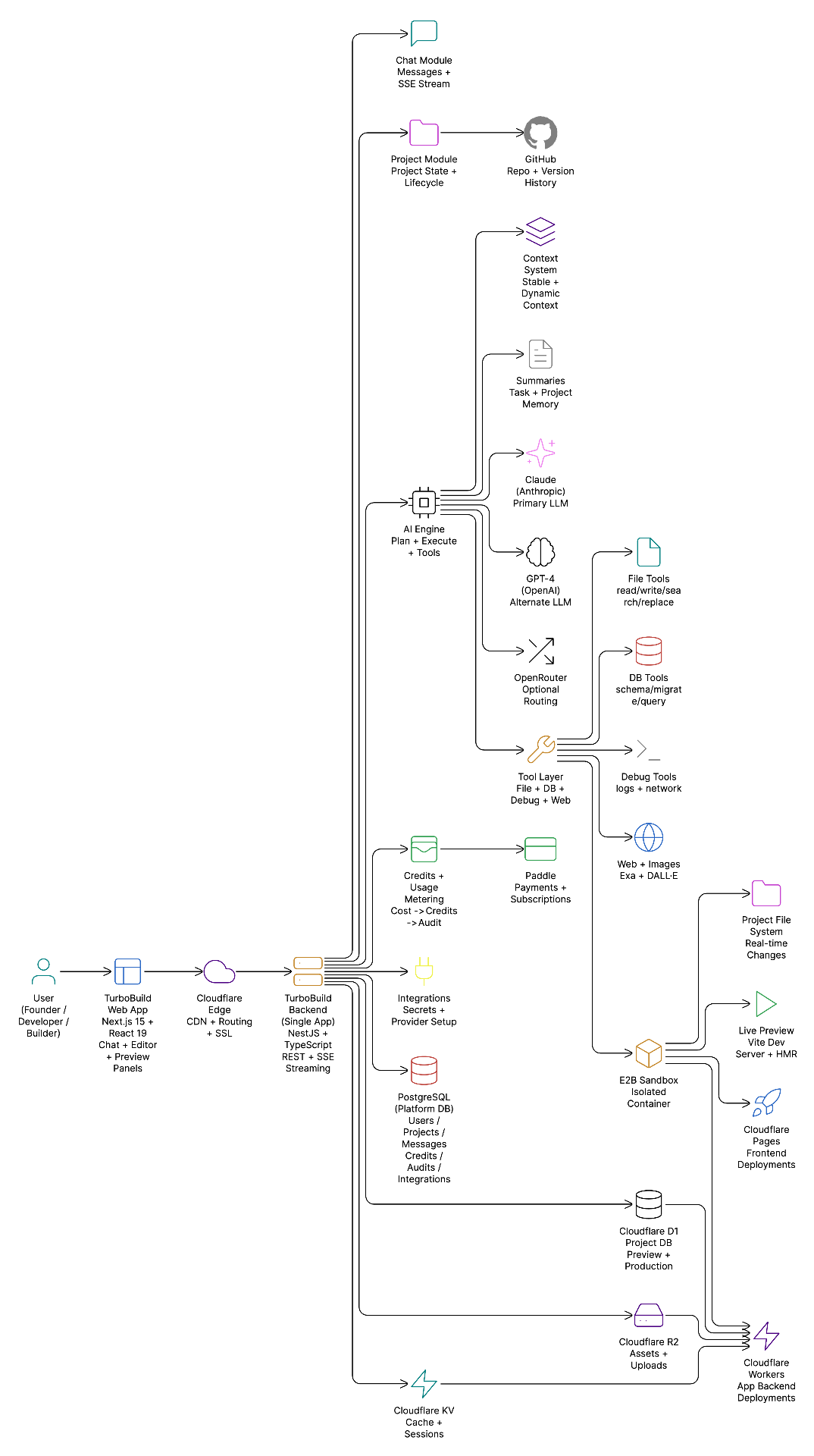
Complete system architecture showing data flow from user to deployment
Next.js 15 Frontend
- Chat + project UI
- Live preview
- Code editor + diff/merge
- Logs / Network / DB panels
NestJS Backend
- Conversation orchestration
- Project + message persistence
- Credit metering + enforcement
- Tool invocation + streaming
AI Provider Layer
- Anthropic (Claude)
- OpenAI (GPT-4)
- OpenRouter (multi-model routing)
Tool Execution Layer
- 22 specialized tools
- File ops, Code ops, DB tools
- Web search, Image generation
- Debug tools, Integrations
E2B Sandboxes
- Real file system
- Dev server (preview)
- Package install + build
- Log capture, Network monitoring
Cloudflare Infrastructure
- Workers (backend runtime)
- Pages (frontend hosting)
- D1 (SQL DB), R2 (storage)
- KV (cache)
Architecture Principles
Modern Production-Grade Stack
Built with cutting-edge technologies for performance and scalability
Backend (NestJS)
Frontend (Next.js)
Infrastructure
External Services
Two-Tier Context Management
How TurboBuild maintains coherence across 1000+ message sessions
The Fundamental Challenge
Long app-building sessions exceed typical AI context limits and inflate costs/latency. Without strong context strategy, AI forgets earlier architectural decisions, breaks patterns, increases token usage, and becomes inconsistent as the project grows.
Stable Context
Cache-Friendly- System prompt
- Project summary
- File tree
- Key 'main files'
- Integrations configuration
Dynamic Context
Turn-Specific- Last ~10 interactions
- Current request
- Recent tool results
Progressive Summarization
TurboBuild compresses long histories into structured summaries that preserve engineering state:
22 Specialized Tools
Deterministic, validated tool execution for reliable code generation
TurboBuild's reliability depends on tool determinism. Tools are first-class modules with input validation, execution logic, error handling, and structured output formatting.
Codebase Manipulation
Debugging
Database
External Operations
Integrations
Why Tools Matter
E2B Isolated Containers
Secure, reproducible execution environment for every project
Sandbox Purpose
Each project runs inside its own sandbox to provide secure execution, reproducible environment, live preview, isolated filesystem, and package installation and builds.
Sandbox Lifecycle
Creation
Sandbox created per project (often reused for speed)
Execution
Code runs in isolated environment with live preview
Termination
Auto-termination on timeout to save resources
Rehydration
Quick restoration when user returns to project
Security First
Container isolation ensures that each project's code execution is completely separated from others, with constrained network policies, resource quotas, and automatic timeouts for safety.
Credit System & Billing
TurboBuild implements a credit-based billing system that provides transparent cost control aligned to actual AI API usage. This ensures users understand exactly what they're paying for and prevents unexpected billing surprises.
How Credits Work
- Real-Time Tracking — Credits are deducted in real-time as AI API calls are made during conversations
- Transparent Metering — Users see credit usage per message and can monitor their balance throughout the session
- Usage-Based Pricing — Credits map directly to AI model costs (input tokens, output tokens, prompt caching)
- Enforcement — Sessions are blocked when credits run out, preventing uncontrolled spending
- Top-Up System — Users can purchase additional credits as needed for continued development
This approach creates a sustainable business model while giving users full visibility and control over their AI development costs. The credit system aligns platform revenue directly with actual infrastructure costs, ensuring long-term viability.
Problems Solved
How TurboBuild overcame key technical hurdles
Context Window Constraints
Long sessions exceed AI context limits, causing forgotten decisions and inconsistency
Summaries + stable/dynamic context split + prompt caching + project-level summarization
Real-Time Preview Reliability
Users need instant, accurate previews during code generation
E2B dev servers + hot reload + streaming updates via SSE + log/network inspection
Cost Predictability
AI usage costs vary wildly, creating billing uncertainty
Token-based cost tracking + real-time credit deduction + abort-on-insufficient with immediate UI feedback
Code Quality & Maintainability
AI-generated code can become spaghetti without guardrails
System-prompt-driven constraints + design-system-first patterns + small component architecture
Deployment Complexity
Production deployment requires multiple coordinated steps
Automated Pages + Workers deployment + D1 migration pipeline + environment binding management
Conclusion
This engagement showcases CyberMind Works' ability to deliver production-ready AI development platforms built for real-world application building and deployment. TurboBuild.ai demonstrates how conversational AI, tool-based execution, and isolated sandbox environments can create a complete development workflow from natural language to production deployment.
By combining two-tier context management with prompt caching, deterministic tool execution, E2B sandbox runtime, and Cloudflare edge deployment, the platform enables users to build full-stack applications through conversation while maintaining code quality, cost control, and production readiness.
Designed for continuous innovation, the system supports long build sessions (1000+ messages), evolving user requirements, and complex application architectures without compromising reliability or user experience. The core strength is not only generating code, but sustaining a real software engineering loop—preview, debug, iterate, deploy—while remaining cost-aware and secure.
About Us
Portfolio
Careers
CyberMind Works LLP
10/15, K.M Towers - 1st Floor, Chakrapani Road,
Guindy, Chennai, Tamil Nadu, 600042
Copyright © 2026, CyberMind Works | All rights reserved.